Why AI Agents Need a Kernel
What it is
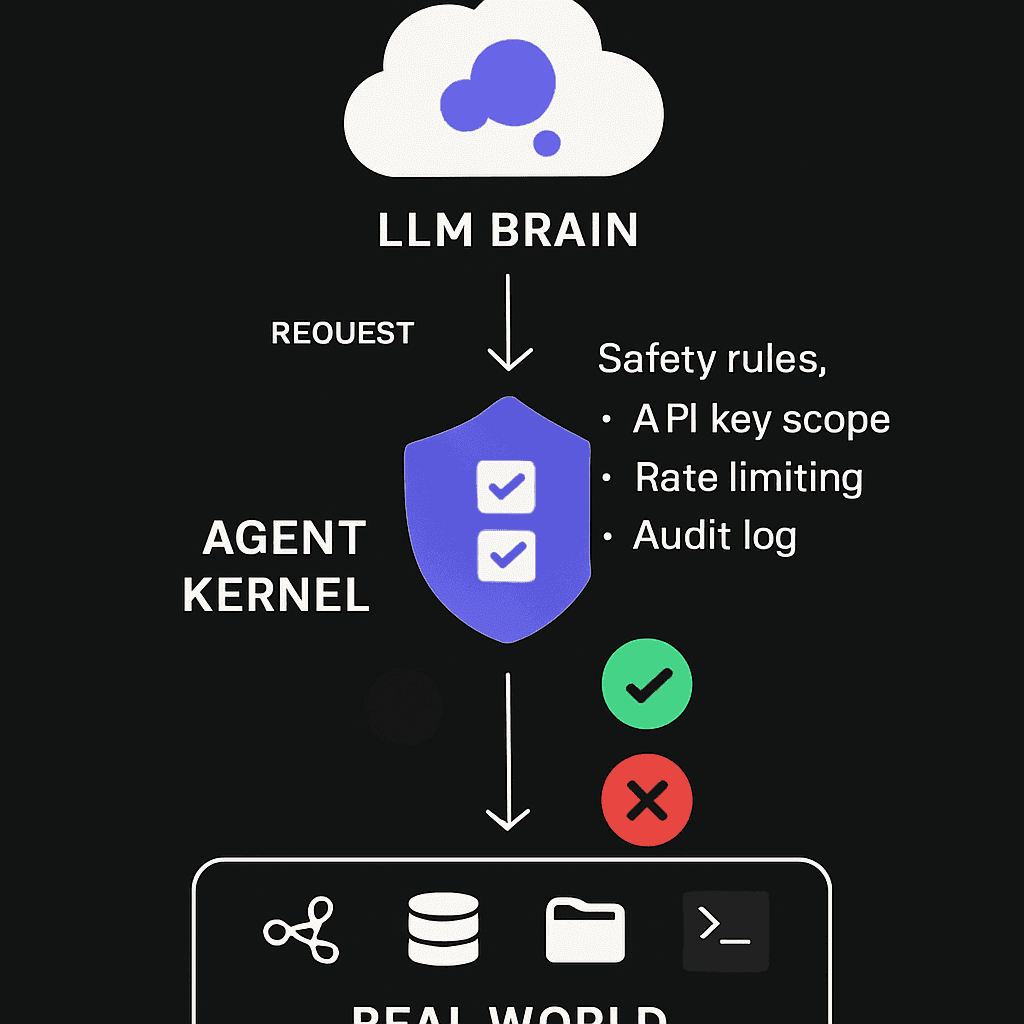
A kernel for AI agents works like an operating system kernel: it sits between the LLM's 'thinking' and actual execution. When an agent wants to call an API, access files, or run code, the kernel manages permissions, sandboxing, and error handling. Picture it as a security guard who checks every instruction before letting it through.
Why it matters
If you're building agents that do more than chat—booking flights, running queries, editing files—you need this layer. Raw LLM output connected directly to tools is a recipe for chaos: leaked credentials, accidental deletions, runaway costs. A kernel architecture lets you ship agents that companies will actually trust in production.
Key details
- •LLMs generate intent; kernels translate that into safe, sandboxed execution
- •Core kernel functions: permission management, resource limits, logging, rollback capabilities
- •Prevents common failure modes: infinite loops, unauthorized API calls, credential exposure
- •Similar to how Docker containers or browser sandboxes isolate untrusted code
- •The abstraction lets you swap LLMs without rewriting safety logic
Worth watching
 19:15
19:15AI Kernel Generation: What's working, what's not, what's next – Natalie Serrino, Gimlet Labs
AI Engineer
Directly addresses AI kernel generation with practical insights into what's working and what's not, providing the technical depth needed to understand why kernels are essential for AI agents.
 19:08
19:08Building AI Agent Workflows with Semantic Kernel
Microsoft Developer
Focuses specifically on building AI agent workflows using Semantic Kernel, demonstrating the practical implementation of kernel architecture in real-world agent systems.
 6:32
6:32What is Microsoft's Semantic Kernel and How to Build AI Agents with It.
David Hendrickson