RAG Without Text: The S-Path-RAG Breakthrough
What it is
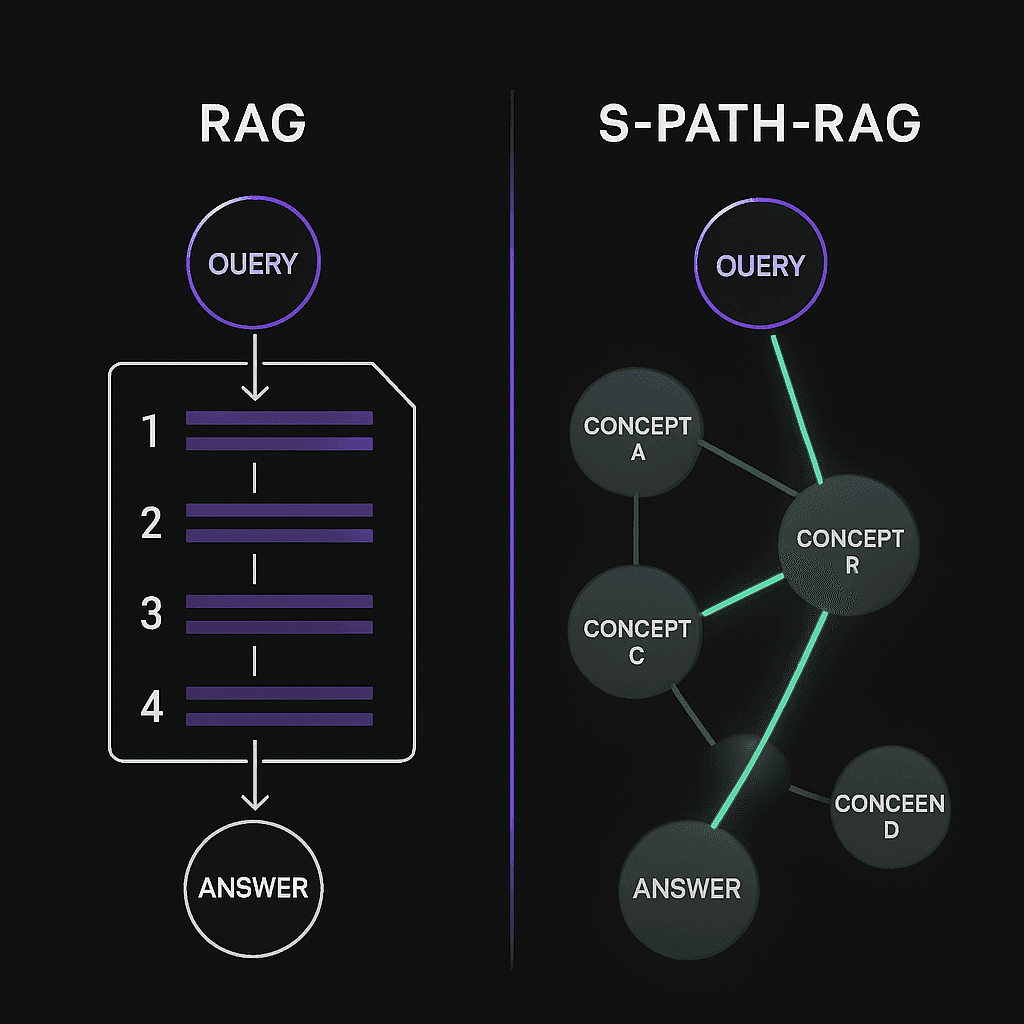
S-Path-RAG treats documents as semantic graphs rather than text chunks. Picture each concept as a node, connected by meaning relationships. When you query it, the system finds the shortest path through this web of ideas—like Google Maps for concepts. No scanning paragraphs, no keyword matching.
Why it matters
If you work with large knowledge bases, this matters. Current RAG burns tokens scanning irrelevant chunks before finding answers. Graph-based retrieval could mean faster responses, lower costs, and better context preservation—especially for complex queries that span multiple document sections. Watch this if you're building RAG systems that feel slow or miss connections.
Key details
- •Uses semantic graphs instead of vector similarity or text chunking
- •Finds 'shortest path' between query node and relevant answer nodes
- •Potentially reduces token overhead by skipping irrelevant document sections
- •Research-stage technique, not yet available as production tool
- •Best suited for structured knowledge bases with clear concept relationships
Worth watching
 6:36
6:36What is Retrieval-Augmented Generation (RAG)?
IBM Technology
This IBM Technology video on RAG fundamentals provides the essential foundation needed to understand how S-Path-RAG improves upon traditional retrieval-augmented generation approaches.
 5:51
5:51What are Transformers (Machine Learning Model)?
IBM Technology
Understanding transformers is critical for grasping how modern RAG systems process and retrieve information without relying on traditional text-based methods.
 0:50
0:50🤖 Agentic AI Explained | NVIDIA GTC 2025 Keynote with Jensen Huang 🚀
AI Beyond Infinity
This NVIDIA keynote on agentic AI explores how AI systems can autonomously reason and retrieve information, which directly relates to the intelligent retrieval mechanisms in S-Path-RAG.