DeepSeek-V4-Flash means LLM steering is interesting again
What it is
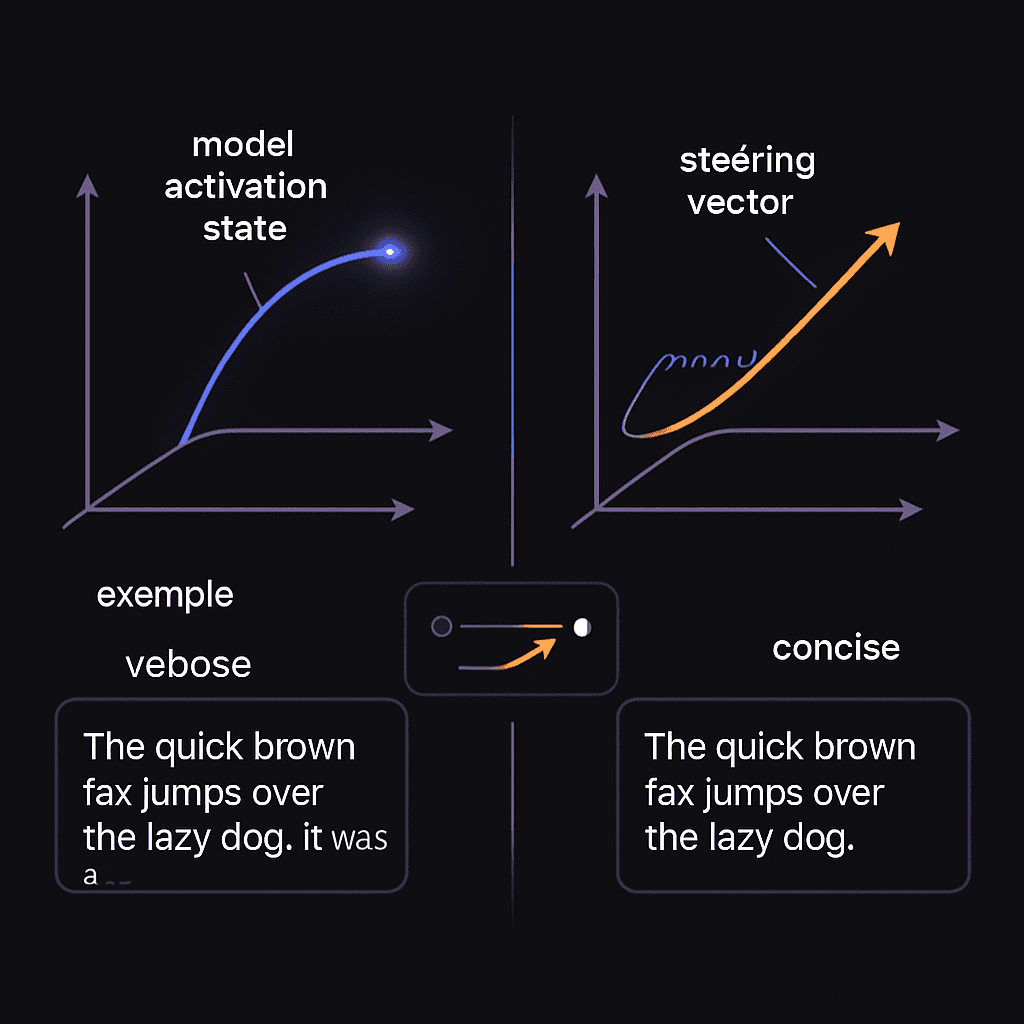
Steering vectors are directions in a model's internal activation space. Picture the model's 'brain state' as a point in high-dimensional space. A steering vector nudges that point in a specific direction—toward 'more formal' or 'less verbose'—without changing the weights. You extract these vectors by comparing how the model activates on contrasting examples (formal vs. casual text), then inject them during inference.
Why it matters
You get precise, reversible control without retraining. Want a model that's 20% more concise only for technical docs? Apply the conciseness vector. Want it back to normal? Remove it. This is faster and cheaper than fine-tuning, and you can stack vectors (concise + formal + cautious). If DeepSeek-V4-Flash's responsiveness isn't a fluke, steering becomes a practical tool for production systems—think model behavior as a mixing board, not a fixed personality.
Key details
- •DeepSeek-V4-Flash shows strong steering responsiveness compared to prior models that largely ignored these interventions
- •Steering vectors are extracted by contrasting model activations on paired examples (e.g., verbose vs. concise completions of the same prompt)
- •Vectors are injected at inference time into specific layers—typically mid-to-late transformer blocks—by adding the direction to residual stream activations
- •Multiple vectors can be combined (e.g., 'concise' + 'formal') by adding their directions, allowing compositional behavior control
- •Unlike fine-tuning, steering requires no gradient updates and can be toggled on/off per request with near-zero latency overhead